What to Study to Become a Sommelier: A Complete Guide to Training, Requirements and Career Opportunities
Find out what you need to study to become a professional sommelier. Requirements, tasting skills, wine cellar management, and career opportunities. Get trained at CETT!
The world of viticulture and high-end gastronomy is undergoing an unprecedented transformation. The traditional figure of the person responsible for the wine cellar has evolved into a highly dynamic, multidisciplinary and essential profile within the HORECA ecosystem—an acronym for HOtels, REstaurants and CAfés/CAtering. If you are wondering what to study to become a sommelier or how to direct your career towards sensory analysis, beverage management and service for demanding customers, this detailed guide analyses the essential skills, the university-level training requirements and the range of professional opportunities offered by today’s sector.
What Does a Professional Sommelier Do and Why Is This a Key Profile?
The role of sommellerie is often confused with oenology or the occasional tasting of wines. However, a sommellerie expert is the key link between wine production, the restaurant business and the consumer’s direct experience. Their primary role is not limited to suggesting a beverage for a particular dish, but also involves designing complete organoleptic experiences that enhance an establishment’s gastronomic offering and guarantee the maximum profitability of its wine cellar.
The day-to-day responsibilities of sommellerie professionals include:
- Comprehensive wine cellar and inventory management: Selecting products, negotiating with distributors, monitoring stock turnover, calculating commercial margins and ensuring the optimal storage of bottles under strict temperature and humidity parameters.
- Strategic beverage list design: Creating a balanced offering that includes local Designations of Origin (D.O.), international wines, organic and biodynamic options, natural wines and alcohol-free alternatives—non-alcoholic pairings—while coordinating each option with the kitchen team.
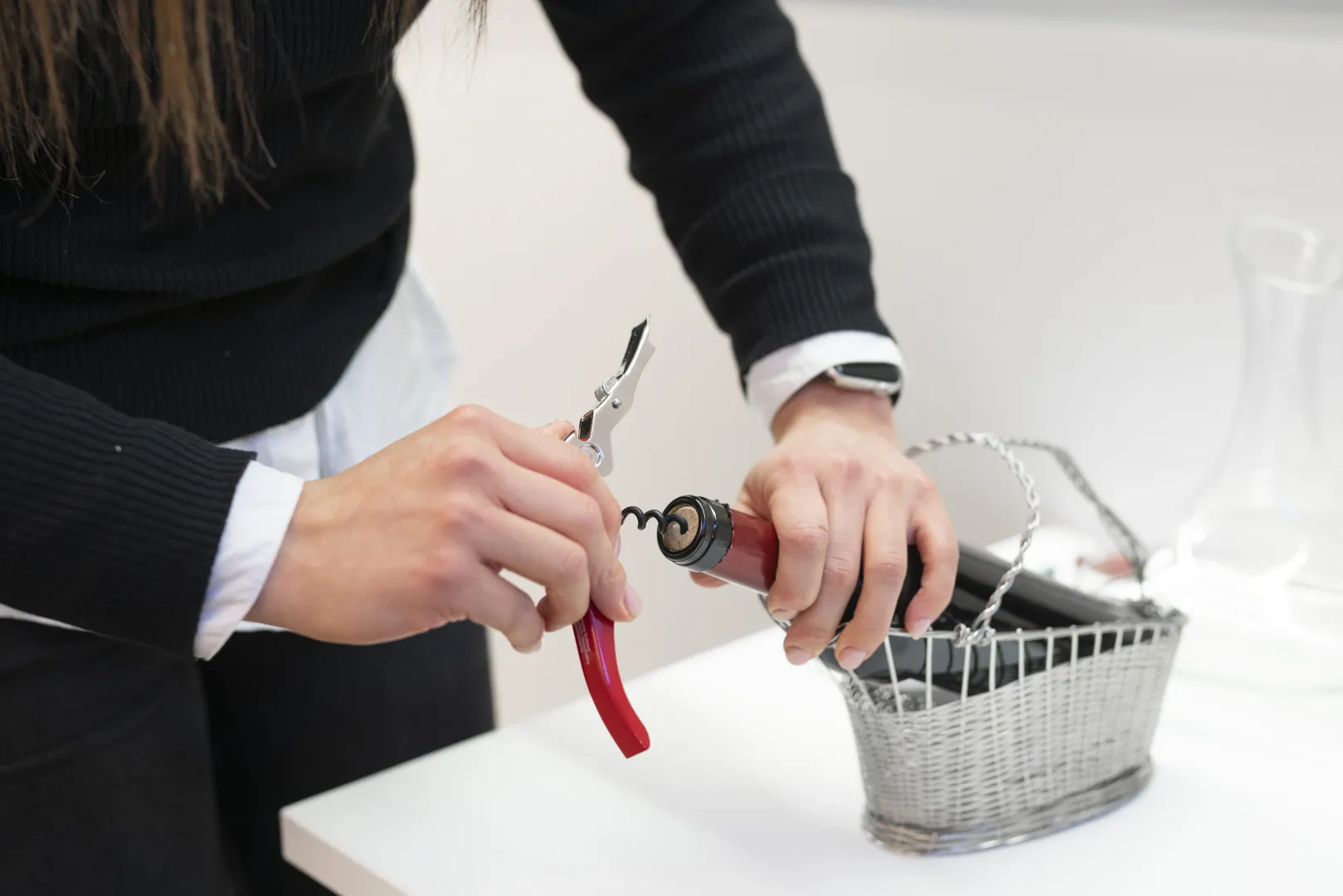
- Dining-room service and personalised advice: Interpreting diners’ preferences to provide tailored recommendations; mastering opening, decanting and serving-temperature protocols; and communicating the history and narrative—storytelling—of each producer.
- Pairing management and sensory analysis: Creating harmonious or contrasting combinations between food and beverages—including wines, spirits, craft beers, teas, coffees and oils—that enhance the organoleptic quality of the restaurant’s offering.
- Leadership and training of the dining-room team: Providing ongoing staff training on product characteristics, strategic recommendation guidelines—upselling—and excellent service techniques.
Fundamental Differences Between Oenology, Wine Tasting and Sommellerie
To approach sommellerie studies, or even an introductory course, accurately, it is important to clarify the conceptual boundaries that separate this discipline from other related branches of the wine sector:
- Oenology: The science and technique focused on wine production, the transformation of grapes in the winery and the control of chemical and biological processes during fermentation and ageing. Oenologists analyse the terroir and the vineyard.
- Wine tasting: A practical sensory-analysis technique used to assess the organoleptic characteristics of a sample—visual, olfactory and gustatory phases. Wine tasting is a tool, not a complete profession in itself.
- Sommellerie: A discipline focused on commercialisation, service, pairing, broad sensory analysis and the direct communication of beverages within gastronomy and specialised distribution. Its main setting is the dining room, the restaurant business and the specialised retail channel.
What Should You Study to Become a Sommelier? Requirements and Training Pathways
Knowing where to study sommellerie makes a substantial difference to your professional prospects. Although a passion for wine and organoleptic curiosity are essential starting points, today’s gastronomic market demands academic rigour, in-depth technical knowledge and business-management skills. Self-directed learning is not enough; structured training leading to an accredited qualification is required.
When assessing the options available within the educational landscape, the programmes with the greatest international recognition and technical prestige stand out for combining:
- Rigorous sensory analysis and a systematic wine-tasting methodology.
- Extensive geographical knowledge of national and international viticulture.
- Financial management applied to restaurants and wine-cellar management.
- Ongoing practical training with active professionals and sector institutions.
En este contexto, cursar un diploma de sumillería impartido por una institución de educación superior adscrita a una universidad pública de prestigio —como el CETT adscrito a la Universidad de Barcelona— garantiza la máxima rigurosidad conceptual. Programas como el Diploma Superior Universitario (DSU) en Sumillería del CETT-UB ofrecen un itinerario completo avalado por organismos oficiales del sector como la Asociación Catalana de Sumilleres (ACS) y la Unión de Asociaciones Españolas de Sumilleres (UAES), capacitando al alumnado no sólo para comprender el producto, sino para liderar departamentos de bebidas y emprender proyectos propios. Si aún estas en una fase más temprana, la mejor opción es Curso de iniciación en Sumillería.
In this context, studying for a sommellerie diploma delivered by a higher-education institution affiliated with a prestigious public university—such as CETT, affiliated with the University of Barcelona—guarantees the highest level of conceptual rigour. Programmes such as CETT-UB’s Higher University Diploma in Sommellerie provide a complete pathway endorsed by official sector bodies such as the Catalan Association of Sommeliers—ACS—and the Union of Spanish Sommelier Associations—UAES. They prepare students not only to understand the product, but also to lead beverage departments and launch their own projects. If you are still at an earlier stage, the best option is the Introductory Course in Sommellerie.
Key Skills You Will Develop in a University-Level Sommelier Course
A high-quality curriculum in sommellerie must provide students with a multifaceted profile capable of responding to technological, sustainability and market challenges. The core areas of learning include:
-
Ampelography, Viticulture and Applied Oenology. In-depth understanding of grape varieties, the influence of soils, microclimates, vineyard training techniques and the different winemaking methods: red, white, rosé, sparkling, fortified and sweet wines, as well as carbonic maceration wines and skin-contact wines/orange wines.
-
Global Wine Geography. Comprehensive knowledge of the major wine regions of Spain and Europe—France, Italy, Portugal and Germany—as well as the wine-producing countries of the “New World”—the United States, Argentina, Chile, Australia, New Zealand and South Africa. Detailed study of their classification systems, legislation and Designations of Origin.
-
Comprehensive Sensory Analysis of Beverages. Intensive training of the senses to identify aromatic descriptors, structure on the palate, wine faults and quality. This tasting methodology is also extended to premium spirits, sake, craft beer, spring waters, cheeses, extra virgin olive oils and delicatessen products.
-
Business Management, Purchasing and Price Architecture. Acquisition of management skills in menu engineering applied to beverages—beverage engineering—cost and margin calculation, computerised stock management, international import logistics and the design of sales strategies that ensure the economic viability of the establishment.
-
Customer Psychology, Communication and Service Excellence. Advanced customer service techniques, assertive communication in several languages, expectation management and mastery of service protocols in fine-dining restaurants, events, specialist shops and independent consultancy services.
Career Opportunities: Where Can You Work Professionally in Sommellerie?
Existe la falsa creencia de que la única salida laboral de l@s profesionales graduados en un curso de sumiller en Barcelona o en grandes centros gastronómicos es la alta cocina. Si bien los restaurantes con estrella Michelin y soles Repsol son destinos naturales, el abanico de empleabilidad es extraordinariamente diverso:
There is a false belief that the only career opportunity available to professionals who graduate from a sommelier course in Barcelona or in major gastronomic centres is fine dining. Although Michelin-starred restaurants and establishments awarded Repsol Suns are natural destinations, the range of employment opportunities is extraordinarily diverse:
- Wine cellar management in top-level restaurants: Leading the sommellerie department in luxury hotels, restaurant groups and gastronomic restaurants.
- Independent gastronomic advice and consultancy: Designing personalised wine lists, delivering tailored training for hospitality teams and carrying out service audits for companies in the sector.
- Commercial management and exports in wineries: Representing wine brands as a brand ambassador, managing key accounts as a Key Account Manager and opening international markets for winery groups.
- Specialist journalism and gastronomic criticism: Writing content for gastronomic media, wine guides and specialist blogs, and creating content for digital platforms.
- Specialist retail and distribution: Managing gourmet shops, high-end wine shops, wine e-commerce platforms and purchasing operations in distribution companies.
- Wine tourism and the revitalisation of wine-producing regions: Designing and managing tourism experiences linked to wineries, wine museums and wine tourism routes.
|
Do you want to transform your passion for wine into a management profession with international recognition? Discover CETT-UB’s Higher University Diploma (DSU) in Sommellerie and learn alongside leading active professionals in Barcelona’s foremost facilities. |
Evolution of the Sector: Trends in Sommellerie You Need to Know
Future sommellerie professionals must train within an ecosystem that responds to the global demands of the contemporary market. The dominant trends redefining the profession include:
- Sustainability and minimal-intervention wines: The significant growth in demand for organic, biodynamic and natural wines requires rigorous knowledge in order to explain their organoleptic characteristics without prejudice.
- Alcohol-free pairings—Non-Alcoholic Pairings: Fine dining has firmly incorporated pairings based on artisanal fermented beverages, kombuchas, botanical infusions and premium dealcoholised spirits.
- Wine cellar digitalisation and e-commerce: The adoption of advanced software for inventory control, wine cellar management using artificial intelligence and commercialisation in digital environments.
| Comparison Criteria |
Sommelier |
Oenologist |
Wine Taster |
| Main Focus | Service, food and wine pairing, sales management, and customer experience in the restaurant and distribution industries. | Wine production, oenological chemistry, vineyard management, and fermentation control. | Ad hoc organoleptic evaluation and identification of sensory descriptors/defects. |
| Usual Workplace | Restaurants, hotels, wine bars, distribution, culinary consulting, and wine tourism. | Wineries, oenological analysis laboratories, and vineyards. | Tasting panels, wine competitions, regulatory committees, and specialized media. |
| Recommended Degree | Higher University Diploma in Sommelier Studies (DSU CETT-UB) / Official Certifications. | Bachelor's degree in Enology or Agricultural Engineering. | Sensory training courses and tasting panel certification. |
| Key Competencies | Wine pairing, menu design, customer service, wine cellar management, storytelling. | Biochemistry, microbiology, viticulture, fermentation management, and aging. | High sensory threshold, olfactory memory, analytical rigor, and objectivity. |
| Direct Customers | Diner, restaurant management, B2B buyer, wine enthusiasts. | Winery, technical management, winegrowers, and distributors. | Gastronomy publications, wine competitions, or the R&D department. |
FREQUENTLY ASKED QUESTIONS ABOUT STUDYING SOMMELLERIE
1. Is Previous Experience Required to Study Sommellerie?
It is not strictly necessary to have previous professional experience in the hospitality industry, although having an interest in gastronomy and sensory analysis is highly recommended. A comprehensive academic programme such as CETT-UB's Higher University Diploma in Sommellerie starts with the technical fundamentals and progresses to an advanced level.
2. How Long Does a University Sommellerie Course Last?
A higher university diploma is generally structured over one academic year (approximately 6 to 9 months of intensive theoretical and practical training), including taught modules, guided wine tastings, winery visits and professional internships.
3. What Is the Difference Between a University Qualification in Sommellerie and a Short Private Diploma?
A university qualification guarantees an accredited curriculum, methodological rigour, a faculty composed of leading industry professionals and researchers, a significant number of hours dedicated to technical wine tasting, and the institutional backing of the University of Barcelona.
4. What Are the Current Employment Prospects for Sommellerie Professionals?
The employment rate in the fine dining and beverage management sectors is exceptionally high. There is strong unmet demand for trained sommeliers capable of managing wine cellars profitably and delivering a differentiated service.
5. What Official Qualification Does CETT's Higher University Diploma Award?
The programme awards a University Extension Diploma issued by the University of Barcelona (UB) and is also formally recognised by the leading professional sommellerie associations, including the Catalan Association of Sommeliers (ACS) and the Union of Spanish Sommelier Associations (UAES).