Ariadna Mostajo, CETT Alumni of the Bachelor’s Degree in Tourism: “Breakfast is one of the most visible ancillary services and one of the most sensitive to customer value perception”
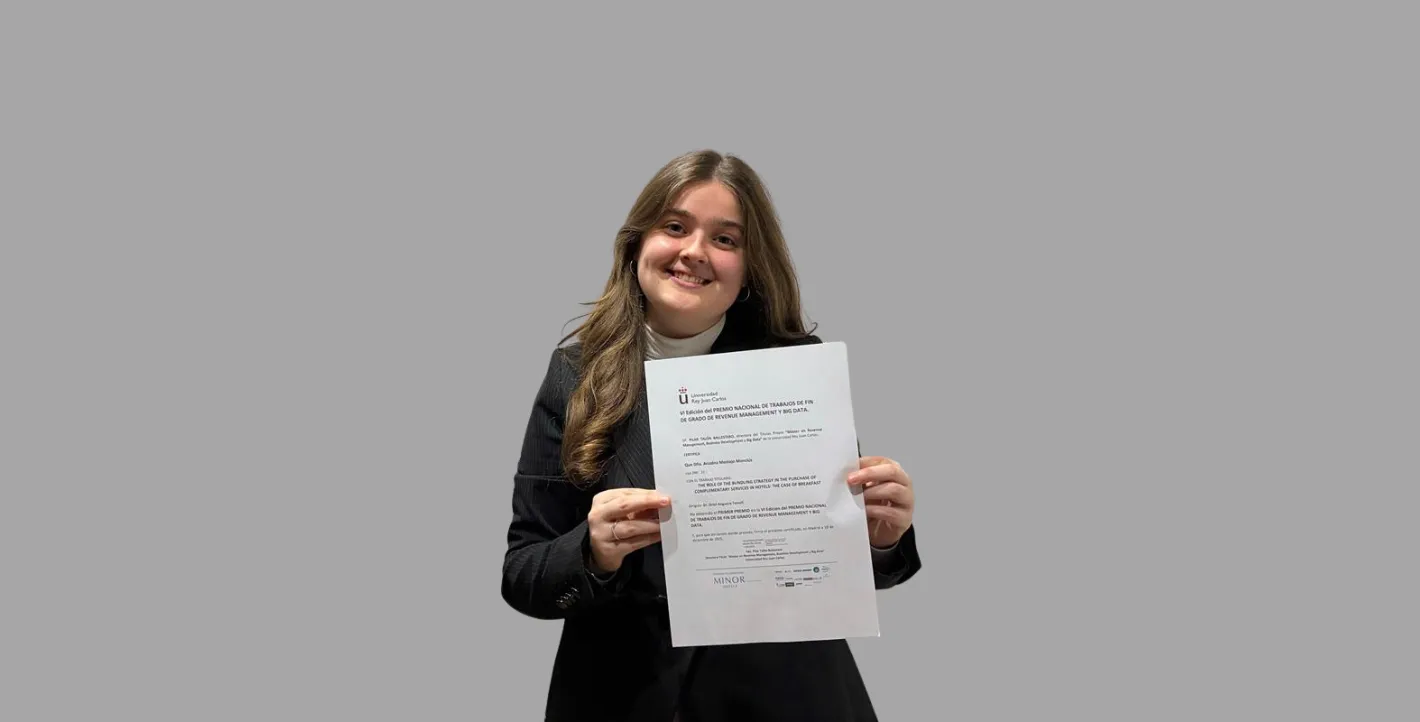
We speak with the CETT Alumni winner of the 6th National Award for Bachelor’s and Master’s Theses on Revenue Management and Big Data about hotel bundling.
Ariadna Mostajo has been awarded an honorary mention at the CETT Foundation Awards for the Best Bachelor’s Theses, as well as the first prize in the 6th National Award for Bachelor’s and Master’s Theses on Revenue Management and Big Data, granted by Universidad Rey Juan Carlos, for her thesis titled “The role of the bundling strategy in the purchase of complementary services in hotels: the case of breakfast.”
The jury of the CETT Foundation Awards highlights that it is a highly applied, rigorous, and exemplary piece of quantitative research, framed within a clear and structured experimental design with direct applicability to the hotel sector. As recognition and support for academic excellence, CETT Foundation has granted her a 50% scholarship for the first year of a Master’s program offered at CETT.
We speak with Ariadna to delve into hotel bundling —a strategy that consists of grouping services into a fixed-price package for customers— and the role of breakfast in these offers.
- Firstly, Ariadna, congratulations on your Bachelor’s Thesis and on all the recognitions you’ve received. What motivated you to study consumer behavior in the hotel sector?
From the very beginning, I was interested in understanding how hotels can influence their customers’ decisions through the concept of choice architecture. The hotel sector combines a high level of competition with increasingly informed customers, which means that small changes in the way a service is presented can have a direct impact on purchasing behavior. My goal was to provide empirical evidence to help understand how to optimize this presentation in order to improve conversion rates for ancillary services.
- They always say breakfast is the most important meal of the day, but what role does it play in hotel bundling strategies?
Breakfast is one of the most visible ancillary services and one of the most sensitive to customers’ perception of value. Precisely for this reason, it is an ideal element for studying bundling.
My research shows that when the service is integrated directly into the initial room rate, conversion increases significantly—by up to 27%. What is most interesting is that this improvement occurs without modifying the base room price and even without offering discounts. Conversely, when the service is offered separately—either during the booking process or even during the stay—its conversion capacity decreases. It’s a matter of perception, nothing else.
- What insights can the hotel sector draw from your research?
The sector can take away a clear message: the way a service is presented is just as important as the service itself. Integrating a complementary service into the initial room rate, such as breakfast, can increase conversion without raising the base price and without diluting the value of the main product.
It’s about how we structure customer choices. In an environment where margins are crucial and differentiation is difficult, understanding these mechanisms can help hotels optimize revenue through decisions that don’t involve changing the product or the price.
- The success of your research is evident through the awards, but what was the process like up to this point?
It has been a demanding but very enriching process. The experimental part required a highly precise design and rigorous data collection to ensure the validity of the results. There was also an intense phase of studying behavioral economics and reviewing literature, because I wanted the thesis to be theoretically well-grounded. Altogether, it has been a profound learning experience in applied research within the hospitality sector.
- What role did CETT and its academic team play in the development of your thesis?
My tutor, Dr. Oriol Anguera-Torrell, played a key role. He helped me orient the work so that it was methodologically solid and had real applicability in the sector. The award is, in part, also thanks to him: his guidance was crucial for the project to reach the level required for research of this kind. I also want to thank CETT for giving visibility to my work and encouraging me to submit it to awards such as these.
- What does winning these awards mean for your academic and professional career?
This recognition strengthens my interest in both research and hotel management. It validates that my work can bring real value to the industry and highlights the effort put into it. On a personal level, it also represents an acknowledgment of the dedication invested both during the research process and throughout my entire academic journey. It motivates me to keep growing and learning.