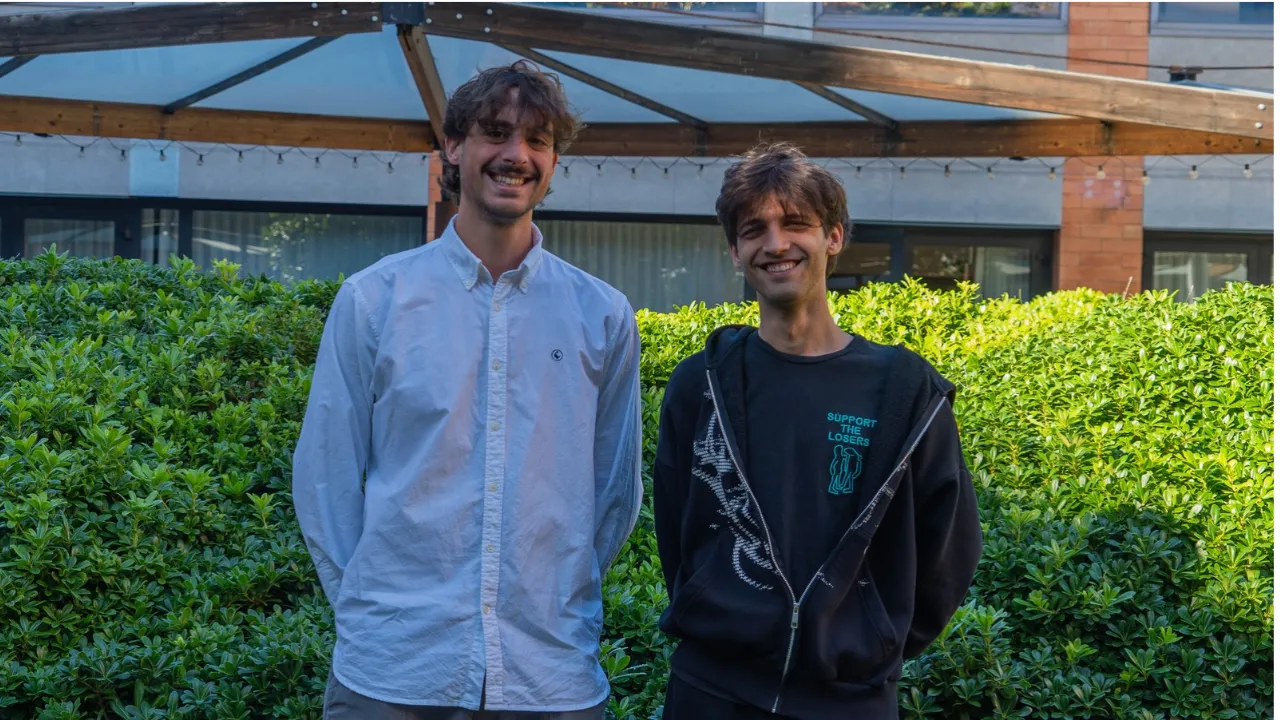
Filip Duran and Mattia Liello, CETT Tourism alumni, win the URJC's National Lola Flecha Award: “Every choice we make has a reason behind it”
Their Bachelor's Final Project, which explores consumer behavior in the car rental industry, has won first prize in the competition.
Filip Duran and Mattia Liello, CETT alumni of the Bachelor's Degree in Tourism, have won first prize in the 7th edition of the National Undergraduate Thesis Awards for their research project, “Understanding Consumer Uptake of Ancillary Insurance in Car Rentals: Purchase Behavior and Determinants.”
The National Lola Flecha Award, presented by Rey Juan Carlos University (URJC), recognizes outstanding bachelor's and master's final projects in the fields of revenue management and artificial intelligence applied to tourism. The initiative celebrates emerging talent and academic research focused on innovation in the tourism industry.
"Understanding consumer uptake of ancillary insurance in car rentals: purchase behavior and determinants"
The study examines the factors that influence consumers' decisions to purchase additional insurance from low-cost car rental companies, a key source of profitability given their low base rental rates. Drawing on behavioral pricing and ancillary revenue theory, the research recommends that companies develop transparent, timely, and personalized offers tailored to each customer's specific circumstances.
We spoke with Mattia and Filip to learn more about their research and experience:
- First of all, congratulations on your Bachelor's Final Project and the award! What inspired you to study consumer behavior in the car rental industry?
Our main motivation was our interest in pricing strategies and how to maximize profitability. Mattia's father owns a car rental company, which gave us access to data that allowed us to gain insight into customer behavior. Beyond the numbers, we were able to explore the psychology behind their decisions and apply our findings to our research.
Throughout the process, we learned about much more than just revenue management. We found it particularly interesting to explore the psychological factors that influence purchasing decisions. Every choice we make has a reason behind it, and understanding people's attitudes led us to consider which strategies could increase the profitability of a business that operates on relatively low margins.
-
Your research has clearly been a success, as reflected in this award. But what was the process like to get here?
The biggest challenge was managing the data. We started with approximately 65,000 data points and had to clean and organize them to determine which information was relevant to our research. Filip spent countless hours programming to filter and classify the data. It wasn't simply a matter of coding; it required extensive programming work.
Throughout this process, our supervisor, Dr. Oriol Anguera, played a fundamental role. He was involved in our project from the very beginning and guided us in choosing the direction we wanted our research to take.
-
In your conclusions, you recommend that companies design timely, personalized offers. What would be the ideal moment to offer this additional coverage (online, at the rental counter, through an email before arrival, etc.)?
The ideal moment to present personalized offers is at the point of purchase. It's also important to bundle payments whenever possible rather than separating them into additional charges, as customers tend to perceive each extra payment as another expense. This is where the psychological component comes into play. It's easier for customers to accept a single, all-inclusive price than to see additional charges added one by one. That's why we recommend presenting everything as a package from the outset.
During our research, we came across a concept we found particularly interesting called “the pain of paying.” It refers to the psychological discomfort we experience when spending money. When we have to make multiple payments, that feeling becomes even stronger.
-
Beyond the characteristics of the car itself, did you identify any demographic profiles or reasons for traveling (business, leisure, family trips, etc.) that make customers more likely to purchase additional insurance?
Families may be among the customers most willing to accept additional charges. Why? Simply because they're tired. After a flight with children and the exhaustion that comes with traveling, all they want is to pick up their rental car and get to the hotel. As a result, they tend to accept additional charges because they want to leave the rental counter as quickly as possible. Customers who are in a hurry are generally more profitable for rental companies.
Business travelers also tend to be more willing to spend extra. However, people who travel frequently for their own business tend to be more cautious and experienced. They usually have a better understanding of the rental process and are more likely to stick to the services they booked in advance.
-
What key lessons can the car rental industry learn from your research?
The first takeaway is the importance of offering additional services at the right moment and presenting them as part of a complete package. We would also emphasize the benefits of booking in advance, since paying for everything together online makes the payment feel less painful.
Based on our findings, we recommend that car rental companies encourage customers to book and pay online before arriving at the rental office. They should also provide personalized offers and present them before customers complete their payments. This not only improves profitability but also enhances customer satisfaction, since most people arriving at the rental counter simply want to pick up their car and leave.
We would also like to highlight that customers increasingly seek personalized experiences. They want services that feel more tailored to their individual needs.
-
How can the industry offer a personalized experience in a service as specific as car rentals?
Personalization can take several forms, particularly when it comes to security deposits. Generally, the deposit amount tends to be the same across different types of rentals, and we believe this should change. Making these costs more flexible can make customers more receptive to accepting other conditions.
The high volume of demand in the car rental industry can make it difficult to personalize every contract. However, adjusting security deposits based on the base rental price is relatively straightforward and can have a significant impact, not necessarily on customers' or companies' finances, but on customer psy hology and satisfaction.
For example, customers' willingness to pay a security deposit may vary depending on the length of the rental. Paying a deposit for a one-day rental can feel more burdensome than paying the same amount for a seven-day rental. Ultimately, in this industry, personalization is less about the product itself and more about pricing, whether through bundled offers or reduced security deposits.
-
What role did CETT and its faculty play in the development of your Bachelor's Final Project?
As we mentioned earlier, our supervisor, Oriol, played a very important role in our project. Working with him was an incredibly rewarding experience, and he helped us discover that completing a Bachelor's Final Project can actually be fun! In fact, since our research has the potential to be expanded, we would love to continue exploring the topic with him.
-
Would you encourage other CETT students to submit their research to competitions such as the National Lola Flecha Award? Why?
Absolutely, and not just because of the award itself. Winning made us incredibly happy. We love winning, who doesn't? And academically, receiving this recognition was the icing on the cake. But there are other benefits, too. You have the opportunity to receive a scholarship, gain access to an academic community that recognizes your work, and build confidence in your professional and academic journey.