Eric Buxó, Winner of the CETT Korean Cooking Competition: “This competition has allowed me to experience the adventure of a lifetime”
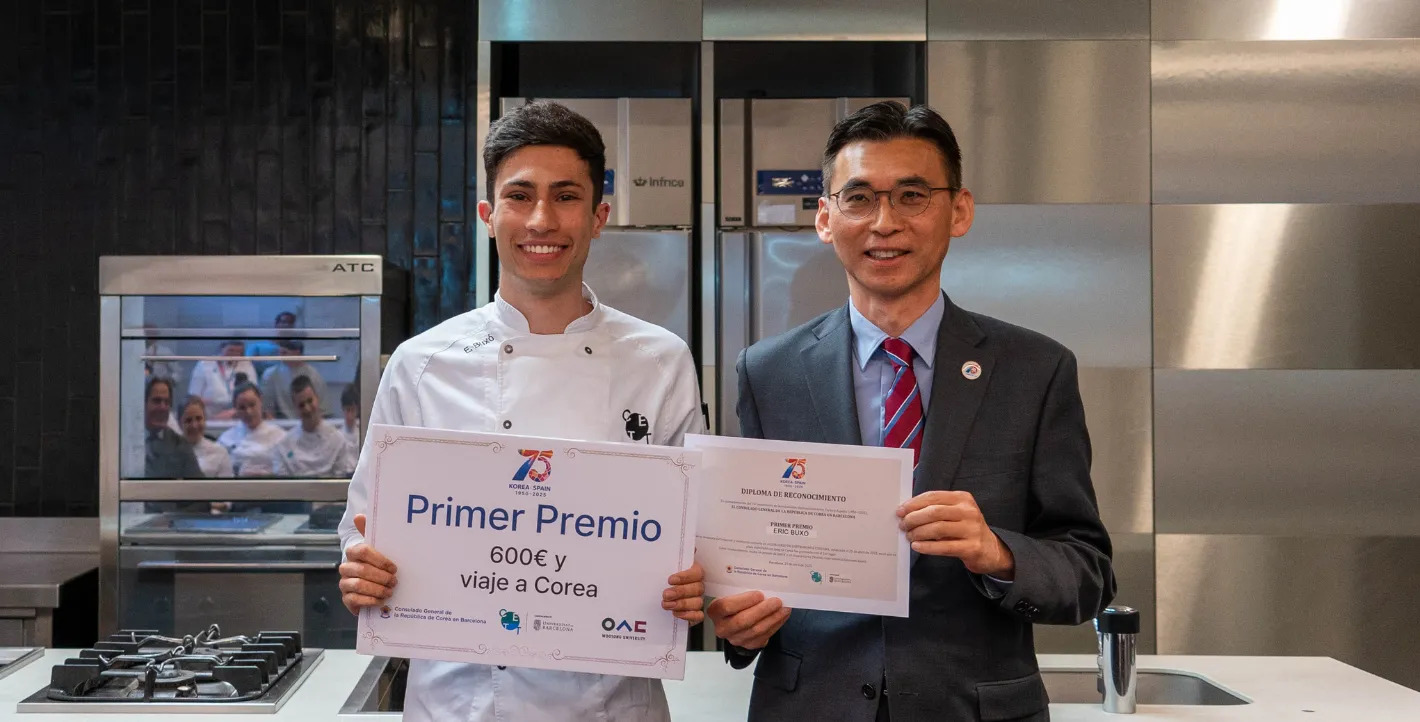
We spoke with the student of the Bachelor’s Degree in Culinary and Gastronomic Sciences about the recognition that led him to compete in a cooking competition in South Korea.
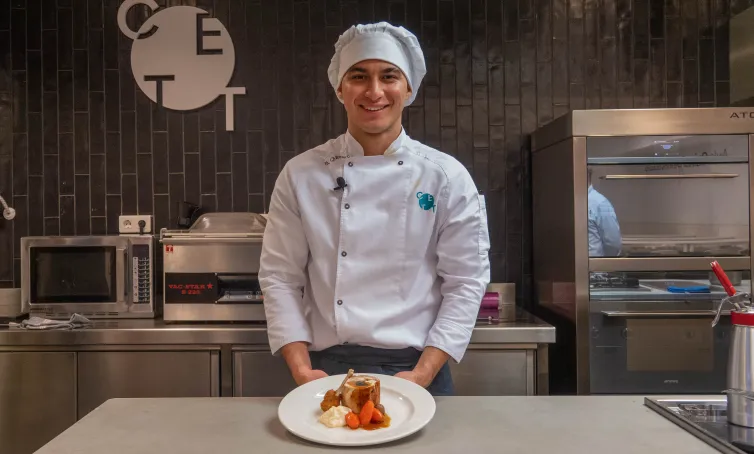
Eric Buxó, a student of the Bachelor’s Degree in Culinary and Gastronomic Sciences, was proclaimed winner of the CETT Korean Gastronomy Competition, held within the framework of the 75th anniversary of diplomatic relations with Korea. This recognition opened the doors for him to take part in the K-Food Master Champion in Korea, where he achieved fourth place among 13 competitors from around the world, surpassed only by representatives from Thailand, Chile and Peru.
Beyond being an enriching international gastronomic experience, this achievement highlights the talent and global outlook of CETT students.
We spoke with Eric to learn what it is like to participate in an international cooking competition:
- This competition was a springboard to Korea. How would you describe the experience?
The trip to Korea was an unforgettable experience, as it was my first time in an Asian country and, above all, my first time taking such a long journey. Both the competition and the trip have been among the best experiences of my life.
- How would you describe the K-Food Master Champion to someone unfamiliar with the competition?
The K-Food Master Championship is a competition held in Mokpo (Korea) that promotes Korean cuisine while incorporating culinary influences from other countries, such as France, Spain or Ireland, for example.
- What challenges and lessons did you take away from the competition?
The main challenge was finding the balance between Catalan and Korean cuisine, as I wanted to harmonize the elements that best complemented each other. In addition, the experience allowed me to learn what it is like to take part in a competition of this scale and understand the importance of prior research in cooking.
- The final recipe was a Korean dish. What differences did you find in the way of cooking and competing between the two countries?
I had never participated in a regional or national competition before, only at university level at CETT, so I did not know what to expect. That said, everyone seemed highly professional, and I would say that the way of cooking and competing there is very different. Everyone takes it very seriously and with great intensity.
Although the way of cooking is quite different, you can always find common elements or ingredients across gastronomic cultures. This is especially noticeable in preparations such as stews or in the fusion of sweet and savory flavors.
I prepared chicken with prawns in the shape of a Japanese-style dumpling known there as mandu, and in Korea I realized that the fusion of meat and seafood is not exclusive to Catalonia with the well-known “Mar i Muntanya.” In fact, it is a common and characteristic technique in Korean cuisine.
- Were you able to exchange knowledge and techniques with other participants?
During my stay, I had the pleasure of meeting participants from countries such as Chile, Peru, France and Ireland. Exchanging opinions and knowledge was inevitable, as we were constantly tasting each other’s dishes. It was a very enriching learning experience because everyone has a different way of doing things.
- Has your perception of Korean cuisine changed over these months?
At first, I knew nothing about Korean cuisine and thought that China, Japan and Korea were all very similar—I grouped them all under the label of “Asian cuisines.” After researching and participating in the competition, I realized that it is a completely different world, with many elements that truly enrich Korean cuisine.
- What does participating in an international cooking competition mean for your academic and professional career?
Right now, I cannot fully assess it because I am just starting out in the professional world. However, during my internships there is always a concept or technique related to what I did during the competition that, thanks to my experience abroad, I can now apply to each dish. It has definitely been an experience that will benefit my professional future.
- If you had to describe Korea in one flavor, what would it be?
For me, Korea tastes like fermentation. Many condiments there have this flavor, such as ganjang, which is similar to soy sauce, or gochujang, a type of spicy paste. It is a flavor present in almost every dish and, in my opinion, it defines the country’s gastronomic essence and the taste of its cuisine.
- What role did CETT and its teaching staff play in your participation and preparation for the competitions?
Without a doubt, CETT played a leading role. At first, I felt quite lost because I did not really know how to approach the competition or execute a dish in an international setting. The teaching staff supported me throughout the preparation phase, helping me improve aspects such as the execution of the dish and organizing my ideas. These elements helped me clearly define the result I wanted to achieve at the K-Food competition.
- How did you come to participate in the competition in Korea?
At CETT, we were informed about the opportunity to participate in a cooking competition commemorating the 75th anniversary of diplomatic relations between Korea and Spain. When I heard about it, I thought: why not? It seemed like a unique opportunity to try to fuse Catalan and Spanish cuisine with Korean cuisine.
I was fortunate enough to win the competition and, therefore, the trip to Korea. From that moment on, the consulate and the organization contacted me to explain the next steps and what my participation in the K-Food competition in South Korea would involve.
- We imagine it was not all about cooking. What would you share about your trip to Korea?
In addition to the competition, I had the opportunity to travel, take a solo trip and discover many important cities. It was a truly different experience, as I had never traveled alone before—especially not to a country so far away. This allowed me to immerse myself in the culture beyond gastronomy: the people and everything that surrounds the territory.
- Would you encourage CETT students to participate in cooking competitions? Why?
Definitely, yes. It is a unique opportunity to grow beyond the gastronomic or academic field. It is a challenge that provides practical knowledge closely linked to classroom theory. I encourage other CETT students to take part in initiatives like this because they are interesting and valuable for personal and professional development.
- What would Eric from a year ago say if he knew he would end up participating in a competition in Korea during his first year of university?
He would not believe it. It was so surprising for me that I did not truly believe it until I had the plane tickets in my hands. Looking back, I would tell him that anything is possible and that with dedication and effort, you can achieve anything.